
Talk through how you swim
Pool, spa, or both; weekends or daily; how warm and how fast. Those answers decide between gas, a heat pump, or both.
Lanterra Pools installs gas and heat pump pool heaters, new or as replacements, on pools and spas from Sugar Land to Katy and west Houston. Which one fits depends on how you use the water: a heat pump is the efficient way to stretch the swim season, while a gas heater brings a spa or a chilly pool up to temperature fast. We help you choose, size the unit, and set it up with the flow, clearances, and supply it needs.
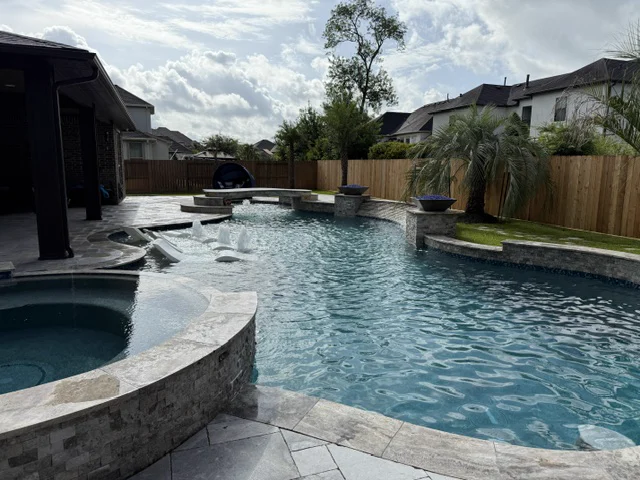
A heat pump pulls heat out of the outdoor air and moves it into the water with a compressor, much like an air conditioner running in reverse. It is economical to run, but it heats gradually and loses output as the air gets colder. A gas heater burns natural gas or propane and heats quickly in any weather, but each hour of run time costs more.
Houston's climate tilts the decision. The months when you are most likely to want heat, March, April, October, and November, are usually mild enough for a heat pump to hold the water at a comfortable temperature if it runs steadily. Hard cold is rare here. If you mostly heat an attached spa for an evening soak, or want the pool warm on short notice, gas is usually the better fit. Some owners run both: a heat pump for the pool and gas for the spa.
Some heat pumps can also run in reverse to cool the water. In August, when a pool in full sun can feel more like a bath than a swim, that option is worth asking about before you buy.
Heater capacity is rated in BTUs, and the right size depends on the pool's surface area, how many degrees you want to gain, how fast you want them, and how much heat the pool loses. Wind, evening shade, and water features all work against you, and a raised spa that spills over into the pool keeps handing its heat to the larger body of water while it warms.
An undersized heater is the regret to avoid: it runs for days and still falls behind on a cool, windy week. A cover makes a bigger difference than most people expect, because much of a pool's heat leaves through evaporation at the surface. If you plan to heat often, a cover lets a smaller unit keep up.
Every heater ships with an installation manual that sets minimum clearances from walls, windows, fences, and roof overhangs, and the install has to follow it. Gas heaters need room to vent exhaust safely and draw in combustion air. Heat pumps need open air around them; boxed in by a fence or shrubs, they pull their own cold exhaust back in and lose efficiency.
A gas heater needs a gas line sized for its BTU input plus every other gas appliance on the meter, and an existing line or meter can fall short of what a pool heater draws. Most heat pumps need a dedicated 240 volt circuit sized to the unit. We check both before quoting. If the gas line, meter, or electrical service needs an upgrade, you hear about it up front so that work happens first. Permit rules for gas and electrical work vary from city to city, so we flag what your city requires.
A heater goes after the filter, so it only sees clean water, and ahead of any chlorinator or salt cell, so concentrated chlorine never flows back through the heat exchanger. A check valve between the heater and an inline chlorinator keeps it that way when the pump shuts off. Heat pumps often get a bypass valve so the flow through the unit can be set to what the manual calls for.
Heaters will not fire without enough water moving through them, so with a variable-speed pump we program a speed high enough for the heater whenever it is called. Over the long run, water balance protects the purchase: low pH water corrodes copper heat exchangers, which is one more reason steady chemistry from weekly pool service matters once a heater is on the pad.
Pool, spa, or both; weekends or daily; how warm and how fast. Those answers decide between gas, a heat pump, or both.
We measure clearances, check the gas line and meter or the electrical panel, and look at pad space and flood exposure before quoting.
We set the heater, plumb it after the filter with a check valve ahead of any inline chlorinator, and connect the controls.
We confirm flow, run a full heat cycle, check for leaks, and show you how to set temperatures and schedules.
Repair for gas pool heaters and heat pumps that will not fire, short cycle, soot up, or stop heating when the weather cools.
Learn more 02Cleaning, sanitizer balance, drain and refill, and heater, jet, and valve repair for attached spas and standalone hot tubs.
Learn more 03One controller for your pump, heater, lights, valves, and salt cell, on schedules you can change from your phone.
Learn moreSend the pool address and what is going on. Lanterra will follow up directly.