
Identify the buildup
We test a small spot to see whether it is carbonate, silicate, or grime, and check what your tile is made of so the method will not scratch it.
Pool tile cleaning removes the white, crusty calcium line and the gray film that build up where your water meets the tile. Lanterra identifies which kind of buildup you have first, because carbonate scale, silicate scale, and oily grime each come off a different way, and the wrong method can scratch glass tile or barely touch the deposit.
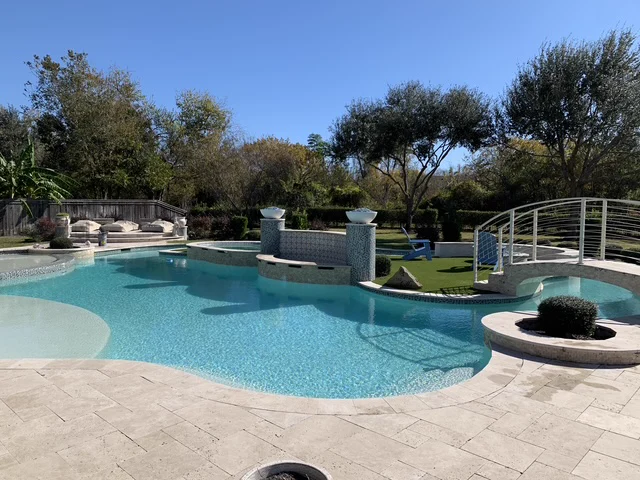
Most waterline buildup in Houston-area pools is one of three things. Calcium carbonate scale is white to light gray and chalky or flaky, and it is the kind that acid dissolves readily. Calcium silicate scale is harder, glassier, and often gray. It tends to build up over a longer stretch, bonds tightly to the tile, and acid does very little to it. The third is organic grime: sunscreen, body oils, pollen, and dust that collect in a dark band right at the surface.
Most pools have a mix. A soft carbonate crust can sit on top of an older silicate layer, with a ring of oily grime above both. That is why one product or one scrub rarely clears the whole line, and why a small test spot comes before the real work.
Scale forms when water holds more calcium than it can keep dissolved, and three local conditions push it there. Evaporation is the first: Houston Intercontinental averages about 111 days a year at 90 F or higher, and every inch that evaporates leaves its minerals behind. Refill water is the second. Sugar Land reports hardness in its main system anywhere from about 35 to 280 ppm depending on the source blend, and Houston's main system reported roughly 44 to 229 ppm in 2025, so every top-off can add calcium. Heat is the third, because calcium carbonate gets less soluble as water warms. A pool that looks fine in April can start scaling in August.
pH matters just as much. When pH drifts high, carbonate drops out of solution and lands on the first surface it finds, usually the tile at the waterline where splashing and evaporation concentrate it. Salt pools run into this more often, because salt chlorine generators tend to push pH upward. Spillways, sheer descents, and raised spa walls scale quickly too, since water is constantly thinning out and drying on them.
For grime and light carbonate, we hand clean with a tile-safe cleaner and a brush or pad suited to the surface. On ceramic and porcelain tile, a wet pumice stone can lift stubborn carbonate spots. Pumice can scratch glass tile and some glossy glazes, though, so it stays off those surfaces.
Heavier carbonate responds to a mild acid-based scale remover applied carefully at the line, then rinsed so it does not throw off the water. Silicate scale is the hard case. It usually needs patient mechanical work or low-pressure media blasting, often called bead blasting, where the water is lowered just below the tile and a fine media is blasted at controlled pressure, then cleaned out of the pool. If your tile has reached that point, we say so up front, explain what the job involves, and let you decide.
Cleaning is half the job. If the chemistry that caused the scale does not change, the line comes back. We look at pH, alkalinity, calcium hardness, and water temperature together, which is what the saturation index measures, and steer the water toward balanced instead of scale-forming. One major salt system manual, for example, asks owners to hold the index between -0.2 and +0.2.
On weekly pool service, the tile line gets brushed and the water gets tested and balanced, which keeps soft carbonate from hardening into something that needs blasting. In hard-water areas, a scale inhibitor added to the water can help keep calcium from settling out between visits. It slows new scale; it does not remove what is already there.
If the plaster below the tile is also stained or rough, an acid wash may make sense at the same time; see how often to acid wash a pool for when that is worth it. If a salt system is driving your pH up, we check the cell and its output settings as part of the fix.
We test a small spot to see whether it is carbonate, silicate, or grime, and check what your tile is made of so the method will not scratch it.
Hand cleaning and tile-safe scale removers come first. Anything that needs lowering the water or media blasting is explained before any work starts.
We test pH, alkalinity, and calcium hardness and adjust toward balanced water, since scale-forming water will simply rebuild the line.
Brushing the tile line and holding pH steady on a regular schedule keeps new deposits soft and easy to remove.
Acid washing for stained, scaled, or dingy plaster, done only when it is the right fix and drained with Houston groundwater in mind.
Learn more 02Same technician, same day each week: a full clean, water balanced for Houston heat and rain, and an equipment check with notes.
Learn more 03Salt chlorine generator installs, salt cell cleaning, and cell replacement, plus the water chemistry that keeps a cell working.
Learn moreSend the pool address and what is going on. Lanterra will follow up directly.