
Test the water and the system
We test salt, pH, stabilizer, calcium, and chlorine with our own kit and compare the result with what the controller reports. A gap between the two points straight at the problem.
A salt water pool system makes its own chlorine from dissolved salt, and it keeps doing that only when the cell is clean, the salt level is right, and the rest of the chemistry is balanced. Lanterra installs salt chlorine generators, cleans scaled cells, replaces worn ones, and keeps the water in range so the system keeps up with a Houston summer.
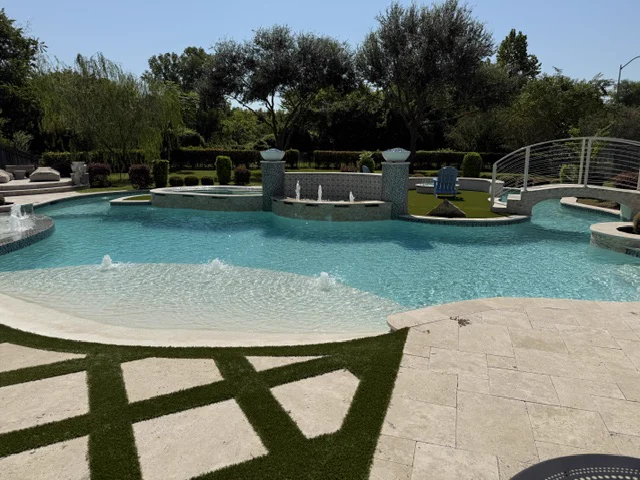
A salt chlorine generator has two parts: a cell plumbed into the return line and a control board at the equipment pad. As water flows through the cell, a low-voltage current across coated metal plates turns dissolved salt into chlorine. That chlorine sanitizes the pool, breaks down, and turns back into salt, so the salt gets reused instead of used up.
So a salt pool is still a chlorine pool. The difference is that chlorine is made steadily at the pad instead of poured from a jug or dissolved from tablets. Most systems call for roughly 3,000 to 3,500 ppm of salt, though the target varies by model, so go by your manual. That is about a tenth of the salt in seawater, which is why most swimmers barely taste it.
Salt does not evaporate. It leaves only with water that leaves the pool: splash-out, backwashing, draining, leaks, and overflow when a storm tops off the pool for you. After a run of heavy Gulf Coast rain, a low salt reading is often plain dilution rather than a failing system.
As a cell makes chlorine, the water right at the plates turns more alkaline, and calcium drops out as a white, crusty scale. Scale blocks the plates, cuts chlorine output, and can make the controller report low salt when the salt is actually fine.
Local water makes this a real issue, and it is not the same from one address to the next. Sugar Land publishes separate hardness ranges for its main system and for areas like Greatwood and New Territory, and Houston's report shows a similar spread depending on which plant serves you. Pools also concentrate hardness over time, because evaporation removes water but leaves the calcium behind, and every top-off adds more. Hot water and high pH speed up scaling even further.
Self-cleaning cells flip their polarity on a timer so the plates shed a thin layer of scale before it hardens. That slows buildup but does not stop it. One major manufacturer says that even with good chemistry, cells typically need cleaning three to four times a year. When scale does build up, the cell comes off for a short acid soak, and then we fix the pH and calcium that caused it. Steady weekly pool service is what keeps that from becoming a monthly chore.
A salt system handles chlorine production. Everything else is still on you or your pool company:
Salt cells protect themselves in cold water. Depending on the model, output scales back around 60 degrees and stops entirely near 50. During a Houston cold stretch the pool needs less chlorine anyway, but if the water stays below the cutoff for days, add chlorine by hand so the level does not bottom out.
Summer is the opposite. Hot water, heavy swimming, and afternoon storms that wash in debris all raise chlorine demand, and an undersized cell can run at full output and still fall behind. A cell rated above your pool's volume has headroom for those weeks, and pump run times have to be long enough for the cell to keep up. Tying the cell to a pool automation schedule makes that easier to manage.
Most chlorine pools can be converted to salt by adding a cell, a control board, and salt. Before converting, we look at your existing equipment and your deck and coping, since salt water can be hard on some natural stone. If you are still weighing it, our guide to salt vs. chlorine pools in Houston walks through the tradeoffs.
We test salt, pH, stabilizer, calcium, and chlorine with our own kit and compare the result with what the controller reports. A gap between the two points straight at the problem.
We pull the cell and look at the plates for scale and wear, then check the flow switch, wiring, and control board.
You get a straight answer on whether the cell is worth cleaning or has reached the end of its life, before any work or parts.
We correct the chemistry, set output for the season, and recheck it so the fix holds.
One controller for your pump, heater, lights, valves, and salt cell, on schedules you can change from your phone.
Learn more 02Same technician, same day each week: a full clean, water balanced for Houston heat and rain, and an equipment check with notes.
Learn more 03Diagnosis-first repair for pumps, filters, heaters, valves, plumbing leaks, and circulation problems on Houston-area pools.
Learn moreSend the pool address and what is going on. Lanterra will follow up directly.