The short version
- Salt systems make chlorine from dissolved salt, so the water is sanitized by the same chemical either way.
- Salt trades a steady chlorine supply for regular pH control and periodic cell cleaning, which matters in hard water.
- Tablet-fed pools slowly build up stabilizer (CYA) through a long Houston summer; the only reliable way to lower it is replacing water.
- Neither system removes the weekly work of skimming, brushing, emptying baskets, and testing.
The real difference is where the chlorine comes from
With a salt system, a cell on the equipment pad turns mildly salty water into chlorine whenever the pump pushes water through it. The salt is recycled rather than used up, so you add more only to replace water that splashes out, gets backwashed, or overflows in heavy rain. The water is far less salty than the ocean, and many people can barely taste it. Your cell's manual sets the exact salt target, and running low can make the cell cut back or stop.
That design has one consequence owners often miss: the cell makes chlorine only while water is flowing. Short pump schedules, a clogged filter, or a power outage mean no new chlorine, no matter how much salt is in the pool. A traditional pool has the opposite weak spot. The chlorine is only as steady as the person adding it.
How a traditional chlorine pool gets its chlorine
In a traditional pool, you or your pool service add chlorine directly. Every form leaves something behind in the water, and that byproduct is what separates them.
- Tablets (trichlor) in a floater or feeder: convenient, but each one adds stabilizer and lowers pH.
- Liquid chlorine: adds no stabilizer and no calcium, but it is heavy to haul and has to be added often in summer.
- Calcium hypochlorite (cal-hypo) powder or tablets: no stabilizer, but it adds calcium, which hard-water pools do not need more of.
- Dichlor granules: easy to dose, but like tablets they add stabilizer every time.
Houston heat, sun, and stabilizer
Bush Intercontinental averages more than 100 days a year at 90 F or hotter, with normal July and August highs near 95 F. Warm water and long sun hours mean high chlorine demand. Sunlight breaks down chlorine that is not stabilized, so outdoor pools use cyanuric acid (CYA) to protect it. The catch is that CYA also slows chlorine down. As a rough floor, free chlorine should stay at about one twentieth of your CYA level, so 40 ppm of CYA calls for at least 2 ppm of free chlorine.
That is where the two systems split. A tablet pool adds CYA all summer, so by August it can be high enough that the usual chlorine level no longer controls algae. A salt pool adds none, so CYA stays where you set it. The recommended level is not settled: one major salt system maker calls for 30 to 50 ppm outdoors, while popular owner guidance for salt pools suggests 70 to 80 ppm so the cell does not have to work as hard. Follow your cell's manual, test CYA monthly, and raise your free chlorine target as CYA rises.
What the routine looks like with each one
Neither system is hands off. The chores just change shape, and in Houston's harder water the salt side carries one extra job: keeping scale off the cell. Calcium builds up as a white crust on the plates, which cuts output and can make the controller report low salt when the level is fine. How often that happens depends mostly on your pH and your fill water, so look up your address in your city's water quality report. Our summer pool chemistry guide covers what local hardness numbers mean.
- Salt, weekly: test chlorine and pH, and add acid when pH drifts up. Salt pools tend to climb in pH, so acid is the routine purchase that replaces chlorine.
- Salt, every few weeks: test salt with your own kit and compare it with the controller reading. A big gap usually points to a scaled cell.
- Salt, seasonally: inspect and clean the cell when the controller prompts you, raise output as the water warms, and keep liquid chlorine on hand for storms and cold snaps when the cell falls behind or shuts off.
- Traditional, weekly or more in summer: add liquid chlorine or refill the tablet feeder, and test chlorine and pH.
- Traditional, monthly: test CYA if you use tablets or dichlor, and switch to liquid chlorine before it climbs past your target.
- Traditional, always: store chlorine and acid apart, in their original containers, and never let tablets and cal-hypo touch. Some pool chemicals react violently with each other.
What each one costs to own, in general terms
Prices vary too much by pool size and equipment to quote here, but the cost shape is predictable.
- Salt: a real upfront cost for the generator and cell, plus installation. After that, occasional bags of salt, electricity to run the cell, and acid for pH.
- Salt: the cell is a wear part. It eventually needs replacing, usually after several years, sooner if it runs scaled up or at high output all summer.
- Traditional: little upfront cost, but you buy, haul, and store chlorine all year, with the heaviest use in summer.
- Traditional: if tablets push CYA too high, the fix is draining and refilling part of the pool, which costs water and time.
- Both: the same pump, filter, and weekly cleaning. Neither one fixes poor circulation or a dirty filter.
Stone, metal, and equipment around a salt pool
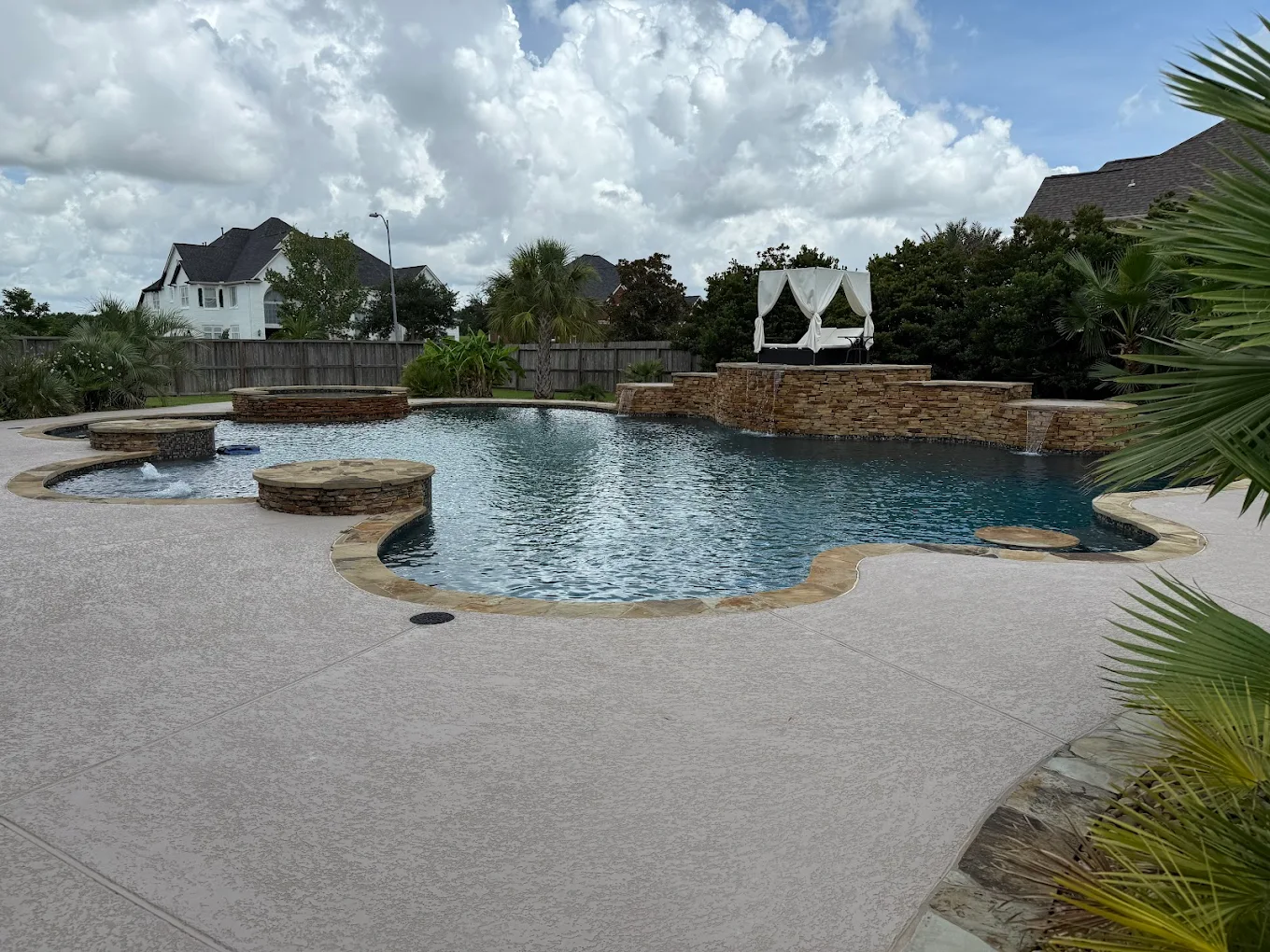
Salt water can be hard on surfaces where it splashes and dries, mainly softer natural stone such as limestone or sandstone in coping, decking, and waterfalls above the waterline. Sealing that stone with a sealer made for salt pools and rinsing splash areas helps. Harder materials are normally much less of a problem.
Metal is the other thing to look at. Heaters, lights, rails, and ladders each have their own guidance on salt water, and an older heater in particular is worth checking before the switch. A pool ringed with soft limestone or a splashing natural stone waterfall is the main case worth thinking twice about switching.
Which one suits your pool
Both work well in Houston when they are run correctly. The better choice depends on how you use the pool and how much of the routine you want to own.
- Salt suits owners who want steady chlorine without hauling jugs, swim often, and will keep up with pH and cell checks or have a service do it.
- Salt suits pools that are already on a variable-speed pump with long daily run times, since the cell only makes chlorine while water flows through it.
- Traditional chlorine suits owners who would rather not buy a generator and replace cells, pools surrounded by soft natural stone, and pools on a regular service route where someone already adds liquid chlorine every week.
- Traditional chlorine also suits rental and vacation homes where nobody is around to notice a cell error light.
Converting, and who keeps it running
Most existing chlorine pools can be converted without draining. Two checks come first: test CYA, because a tablet pool with very high stabilizer is better reset by partly replacing the water before the switch, and confirm that your heater, light, and any metal fixtures are rated for salt water. Lanterra installs and services salt water pool systems, and our weekly pool service covers either kind of pool: the same technician tests and balances the water, checks the cell or adds chlorine, and leaves notes after each visit.