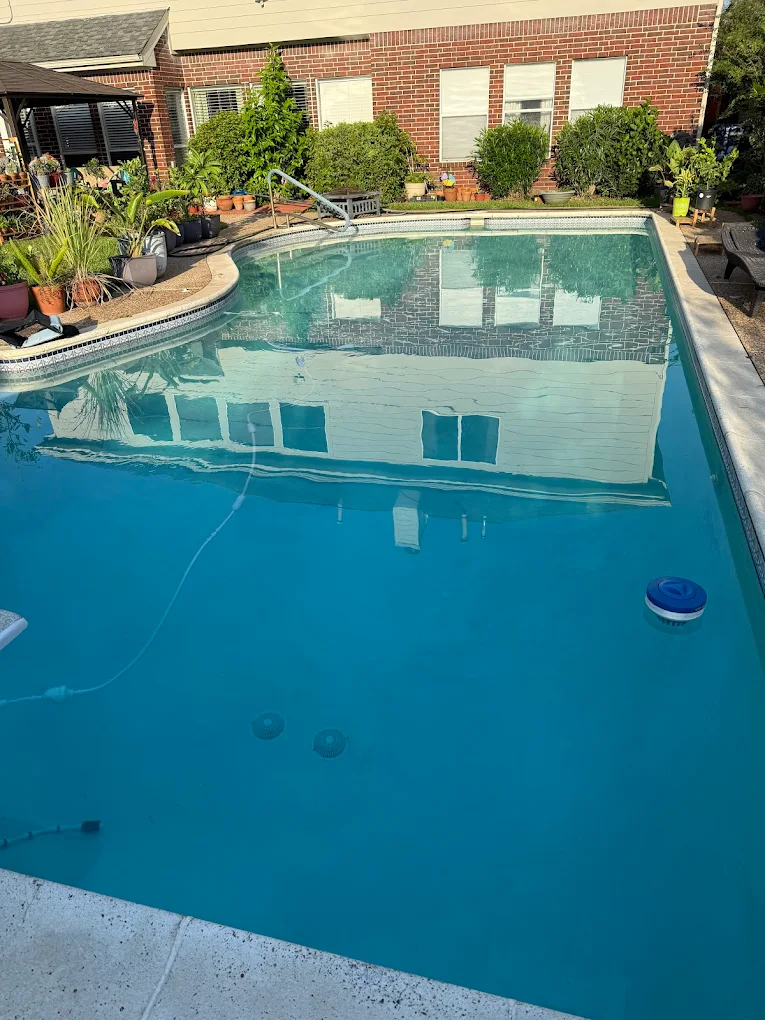
The short version
- Do not drain a pool after heavy rain. The weight of the water is what holds the shell down in saturated ground.
- Leave the breakers off until the equipment pad is dry, and have any motor, heater, or control that sat in floodwater checked before it runs.
- Pull leaves and limbs out by hand first so they do not jam the skimmer, pump, or cleaner.
- Shock strength depends on your stabilizer (CYA) level. Test first, then hold that chlorine level until the water is clear and stops losing chlorine overnight.
- If you cannot see the main drain, nobody swims yet.
Why a storm turns a clear pool green so fast
A big rain does three things to a pool at once. It dilutes the chlorine, it washes in leaves, soil, pollen, and lawn runoff that use up whatever chlorine is left, and it often knocks out power so the pump stops moving water. Add Houston's warm water and algae has everything it needs to take over quickly.
This is not only a hurricane problem. The Atlantic season runs June 1 to November 30 and peaks around September 10, but June is the wettest month of a normal year at Bush Intercontinental, and spring thunderstorms do the same damage on a smaller scale. Green after a storm is a chemistry and circulation problem, and it is fixable.
Safety first, before you touch the pool
Walk the yard before you grab a net. The pool can wait an hour; a shock from wet equipment cannot be undone.
- Stay clear of downed power lines. If a line is touching the pool, the fence, or standing water in the yard, keep everyone away and call your electric utility.
- Never touch equipment or a breaker while you are standing in water. Leave the pool breakers off until the pad, the timer box, and any control panel are completely dry.
- If the pump motor, heater, or controls sat in floodwater, have a pool technician or qualified electrician check them before they run again. Water inside a motor or a gas valve is not something to test by flipping a switch.
- Check your pool chemicals. Containers that got wet or tipped over can react with each other, so keep each product separate, sealed, and in its original container. Do not sweep or hose spilled products together. If you smell strong chlorine or see fumes, leave the area and call 911.
- Look at the fence and gates. A damaged barrier around a murky pool is a drowning risk for kids and pets.
- Stay out of the water until you can clearly see the bottom and the main drain.
Lower the water to the skimmer line, and no further
Muddy water makes a fresh start look appealing, but emptying the pool is the one move that can turn a cleanup into a structural repair. Wet ground pushes up on the shell, and the weight of the water is what keeps it seated. An empty pool in waterlogged soil can crack or pop out of the ground, so starting over with new water is a decision for a pool professional, not a storm-day reflex.
What you do want to remove is the rain on top. When the water rises past the skimmer opening, floating leaves sail right over it and the pool cannot clean its own surface. If your filter valve has a waste or drain setting, use it once the equipment is cleared to run; otherwise a small submersible pump with a hose aimed away from the house works. Watch it the whole time and stop at the middle of the skimmer opening. Never let the level drop below the skimmer, or the pump will suck air and can run dry.
Get the debris out before the equipment runs
Leaves and twigs are what jam a pump impeller or a cleaner. Remove as much as you can by hand before you restart circulation.
- Skim the surface with a leaf net, then use a deep leaf rake or bag net on the floor.
- Empty the skimmer basket and the pump basket, and check that the pump lid O-ring is clean and seated.
- Brush the walls, steps, and floor so algae and silt lift into the water where the filter can reach them.
- If the floor is covered in fine silt and your filter valve has a waste setting, vacuum that silt to waste so it never reaches the filter. Add water afterward to bring the level back up.
- Hold off on the robotic or suction cleaner until the big debris is gone.
Restart the filter and watch the pressure gauge
Once the equipment is dry and checked, switch the breakers back on from a dry spot, turn the pump on and confirm it primes and moves water. Run it around the clock until the pool is clear. Circulation is half the cure.
Note the filter pressure when the filter is clean, then watch it. Most filters need cleaning or backwashing when the gauge reads about 8 to 10 psi above that clean starting pressure; your filter's manual has the exact number. Expect to do it more than once, because dead algae and silt load a filter quickly during a cleanup. A filter that is clogged keeps the water cloudy no matter how much chlorine you add.
Shock to the level your stabilizer calls for
Test before you pour anything. You need free chlorine, pH, and cyanuric acid (CYA, the stabilizer). CYA protects chlorine from the sun, but it also slows it down, so the higher your CYA, the more chlorine it takes to kill algae. That is why a single shock dose from the bag rarely clears a truly green pool. Use a pool chemistry calculator to find the shock level for your CYA, then hold it there.
Bring pH into the 7.2 to 7.8 range first so the chlorine works efficiently. Then add liquid chlorine or another unstabilized shock, retest several times a day, and top it back up as algae burns through it. Avoid chlorine tablets for this job, since they add more stabilizer every time they dissolve. Never mix chlorine and acid, and add each one to the pool separately, well apart in time.
Keep going until all three of these are true, not just until the water turns blue:
- The water is clear, with no visible algae, alive or dead, on the floor or walls.
- Combined chlorine is 0.5 ppm or lower.
- The pool loses 1 ppm of free chlorine or less overnight, from sunset to morning.
Salt pools and cloudy pools need a slightly different approach
If you have a salt system, do not count on the cell to recover a green pool. It produces chlorine slowly by design and cannot keep up with an algae bloom. Turn the cell off while you shock with liquid chlorine, so you can control the level by hand, and turn it back on once the pool passes the overnight test. Rain also dilutes salt, so retest the level before you rely on the cell again. Our salt vs chlorine guide explains how the cell fits into the routine.
Cloudy water with good chlorine is usually a filtration issue: fine silt, dead algae, or a filter that needs cleaning. Keep the pump running, clean the filter when the pressure climbs, and give it time. Floodwater can also carry sewage and phosphates, so if the yard flooded, treat the pool as contaminated and do not swim until the chlorine has done its work and the water tests in range.
When to call a pro
Plenty of owners clear a lightly green pool themselves. It makes sense to hand it off when the job stops being about chemistry. Lanterra's green pool cleanup handles the shock, brushing, filter cleaning, and follow-up visits, and pool storm cleanup covers heavy debris and silt. We diagnose the equipment before we quote and tell you plainly whether a repair is worth it.
- The pump, heater, or controls were under water.
- The pump will not prime, runs hot, or the breaker trips.
- There are limbs, mud, or a layer of silt on the floor.
- You see new cracks in the deck, coping, or tile, or the water level keeps dropping after the rain stops.
- The water is still green after several days of holding shock level.